



OUT OF TUNE · Marginal Readings
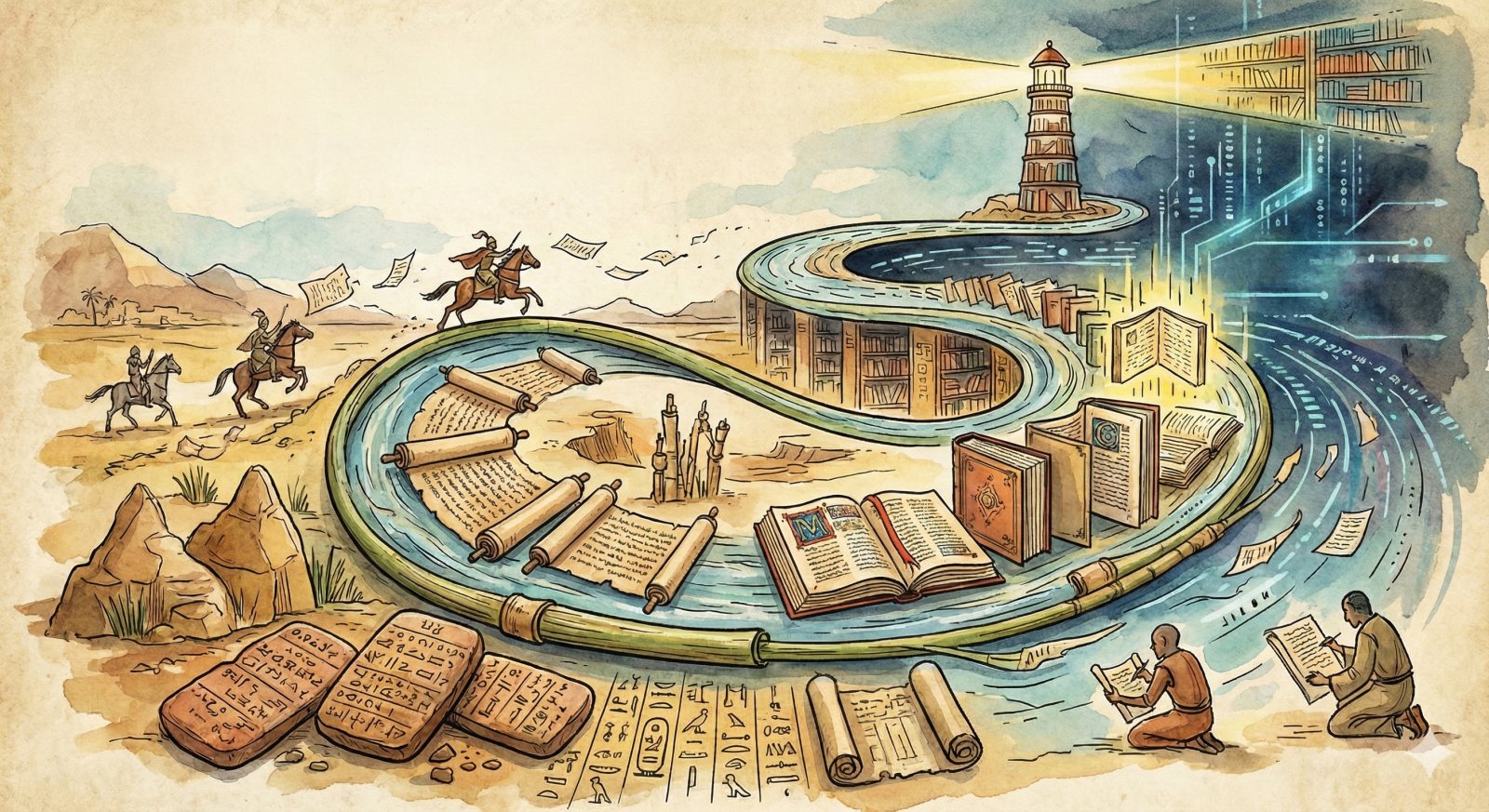
AI-generated cover illustration.
I think that's all that's important to say about the book. Infinity in a reed, The words of Irene Vallejo have already been spoken about by the most authoritative voices in world literature. But as the author of these words destined for oblivion, I feel I cannot remain silent in order to satisfy this secret ego that compels me to meddle where I have not been invited.
In that sense, saying more than some commonplace about one of the most extraordinary books I have read throughout my boring life (for others) My life as a reader is, although a poor elegy, but an elegy nonetheless, the best reason I can find to write about books and authors I prefer.
Vallejo not only wrote a beautiful and highly cultured book, but he has created a Gantt chart-like map of the history of books and their predecessors: from the dawn of time (That's another book, just in case.) of humanity, up to this time.
It is impossible for anyone to deny that we live saturated with high-tech devices that are shamelessly dehumanizing us on a planetary scale, where the owners of the world no longer hide their excessive ambitions or their criminal reach to give the world population an invisible Greek present.
Today, these influences reach everyone from the streetwise thinker to the educated worker and the privileged young man, all manipulated through half-truths and lies. Each one is experiencing the consequences of an unstoppable infodemic that, more often than not, disguises images and stimuli brimming with boundless and shameless imbecility and hatred.
Perhaps that is why, from its simplest intention to the erudition made magic, the marvelous journey that Vallejo gives us on each of her pages is more than a complex invitation to read about the history of books in this ever-devious world; it is also an unequivocal and unnuanced provocation to the intellect, the dedication and the sense of journey that the author offers us on each of her pages.
They contain stories about those hunters of silent prey who rode on their steeds through the ancient world in search of any glimpse of the word “written” and superimposed on the most disparate materials that could bear them. Acquiring them in turn by any means, not always legal or ethical, for these hunters of ancient texts knew that other men had left the most diverse legacies about peoples and civilizations that deserved to be known by future generations.
To enter the whirlwind of the story that Vallejo offers us in her book Infinity in a reed It is, above all, a gift of the most exquisite nature. Here one can encounter erudition, fantasies, journeys, and characters about the history of books throughout human development. Those same books that, with the passage of time, found their first space of their own (even if it wasn't always respected) such as the first libraries that we know ever existed.
From the tablets of Mesopotamia to today's intricate data centers, which seem to have a life of their own, every idea, every dream, every adventure surrounding knowledge and human progress, to a greater or lesser extent, has always been with us thanks to the fact that they were captured by some visionary who has never stopped dreaming of grasping the infinite to give us his view of the world.
Irene Vallejo has done it, and succeeded without reservation. Now only you remain, elusive reader, to “immolate yourself” in the adventure of the possible through reading this or others old books read by this reader with aspirations of being a literary commentator and which we will be commenting on in this platform, which has dared to allow this pamphlet to reach you.
Leave a Reply