


Author's note: The surname of the main source and their spouse has been omitted at the request of the interviewees, in order to protect their privacy, their safety and their job position within the institution.
October 18th was his day off, and he had decided to spend that Friday relaxing and playing soccer. However, he found it difficult to unwind. Not because of the thesis he had to submit in December, but because he was thinking about the police officers who had been working since 6:00 a.m. due to the massive fare evasions on the Metro. As an officer in the force, Claudio didn't like the idea of standing idly by while his colleagues carried out their duties under such challenging conditions.
He suspected he might be called up to support the Special Forces, even though, due to his academic training, he hadn't served on the streets for five years. Aside from the basic knowledge every uniformed officer possesses, Claudio hadn't received any further training on protocols for dealing with street demonstrations. Even so, he wanted to go and help. This feeling only intensified that night., Television showed the fires in the subway stations. During the early morning of the 19th, the order came to report for duty and support the work on the ground. “The call of duty,” Claudio would later say. He never imagined all that was to come. That day, Chile awoke and did not look favorably upon the Carabineros.
The carabineer
Claudio has the appearance of a calm person. His family and friends agree. Perhaps that's his most striking characteristic, aside from a graying streak that looks out of place in his black hair. He's 29 years old, with soft features, full cheeks, and somewhat expressionless, not very large eyes. It's hard to imagine him in riot gear from the Special Forces, holding a pellet gun. "He's not your typical street cop. He's more of an office-bound cop, with his engineering degree and master's," explains his wife, Andrea. And it's no wonder: of the 12 years he's been with the force, he's dedicated the last 5 to completing his studies at the Police Science Academy. He also trains for marathons. "He's a very persevering man who lives his life as a Carabineros officer to the fullest," explains his coach, José, who has known him for 10 years.
During his time as an officer, he has experienced various demonstrations, such as the student protests of 2011 while working in the O'Higgins Region. However, his last memories working on the streets were nothing like what he would experience starting on October 19th. “The total change was shocking. Besides, I came with the image of the provincial police officer, the one who helped with everything; for any problem that came to mind, they would call a police officer […] and entering this… it was shocking.”.
21 days after D-Day
The most difficult day Claudio had to work was November 8th. By then, 21 days had passed since the beginning of the social uprising. Figures from the National Institute for Human Rights (INDH) indicated that by 2:00 PM that Friday, there were 5,565 detainees and 1,915 injured people.See source182 of them had eye injuries. That same day, Gustavo Gatica lost his sight due to pellets fired by the Carabineros, along with 8 other people who suffered eye injuries.
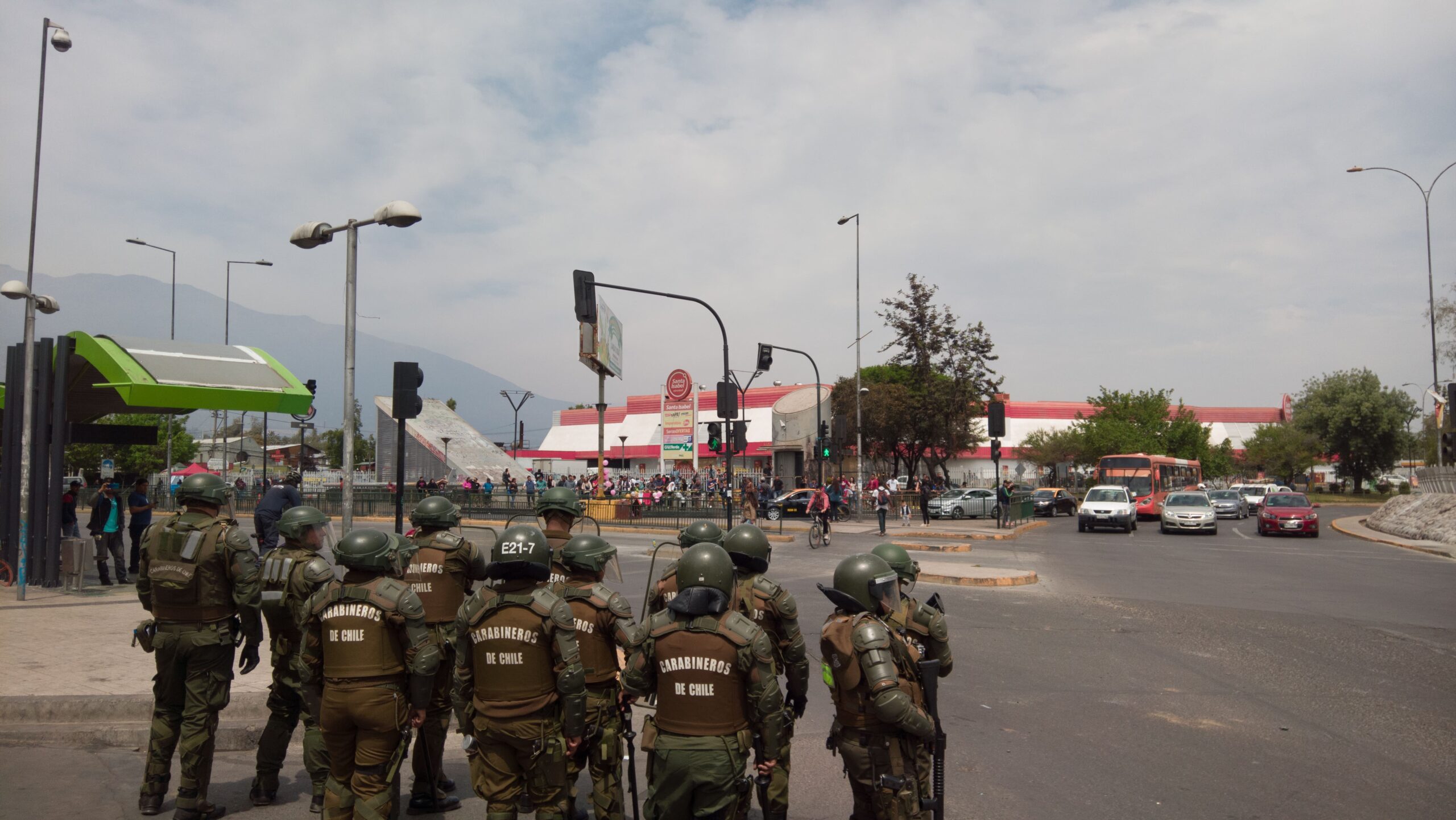
Claudio knew that day wouldn't be easy. He'd been assigned to a key point in the conflict: the intersection of Avenida Vicuña Mackenna and Carabineros de Chile Street, just meters from Plaza Baquedano (also known as Plaza Dignidad). At that hour, before the columns of protesters arrived, the area around the plaza already resembled a deserted battlefield. But it was only a matter of time before the scene changed; the following day, the Metropolitan Intendancy would estimate that more than 70,000 people had attended the march.
Plaza Dignidad was not a safe place for a police officer. According to official government statements, at the beginning of that week there were 947 officers injured as a result of their work at demonstrations, although Cyber I would question this figure by reducing it to 161.
Claudio hadn't been sleeping well for days, and wearing the protective suit for so many consecutive days was exhausting. However, he fully understood that without it, he was very likely to come home with more than just a bruise.
He was expecting the arrival of protesters or for something to happen that would require the intervention of his squad of Carabineros. As had been the case since the beginning of the crisis, Claudio was tasked with leading a section of the officers on the ground. He had the confidence to do so thanks to his experience and training. Eventually, the time to act arrived. While some marched peacefully to the rhythm of "El Baile de los que Sobran" by Los Prisioneros, others were already preparing to confront the Carabineros. "(That day) I witnessed a level of violence I had never seen before," Claudio would say a month after the events.
The protest was scheduled for 5:00 PM, but the clashes began earlier. First came the chants: “Cop, faggot, fight without a water cannon,” “fucking cop, pimp of the State,” among others. Suddenly, stones, metal rods, and metal pellets began to fly. They even used barbed wire to puncture the tires of the police vehicles.
Despite their efforts, Claudio's group was forced to retreat two blocks down Vicuña Mackenna, at the same time the march was scheduled to begin. The masked protesters took advantage of this to build barricades in the street with posts, debris, and two kiosks. No matter how many tear gas canisters were fired, they couldn't disperse them. There were simply too many to confront. "(I saw) a mass of more than 2,000 people whose only goal was to attack the Carabineros." That night, his wife Andrea would wait up for him until late.
The battle would last until nightfall. In the meantime, the Plaza Italia Campus of the Pedro de Valdivia University would be set ablaze, the Church of the Assumption would be looted, and the Argentine Embassy would also be attacked with stones and Molotov cocktails. Only well into the night was Plaza Dignidad able to return to relative calm.
“What they say is true,” Claudio recounts later. “The people united will never be defeated.” Days like that were to come.
The flip side of the explosion
His voice is tired as he speaks on the phone. A month has passed since the events he described, but he has continued working at the same pace. Thanks to his profession, Claudio has had a privileged position to witness the aftermath of the destruction, what remains after the marches. He describes seeing firsthand the helplessness, anger, and sorrow of people whose homes were looted, and how he personally went to great lengths to help them, whether by carrying bags for them or using his body as a shield. By mid-November, the National Confederation of Micro, Small, and Medium-Sized Enterprises of Chile (Conapyme) estimated that 20,000 companies could declare bankruptcy as a result of the social unrest. “Many Chileans have not been able to grasp the magnitude of this social crisis and the crime that this crisis has generated,” he states.
“We’ve held on for quite a while,” says Claudio after nearly two months of working at protests. He certainly has the stamina; he was recently informed that he will be able to resume his studies to finish his academic preparation, so he will no longer have to wear the Special Forces uniform. What gave him strength during all this time were the expressions of affection from his wife, family, and the many others who have silently supported them.
He doesn't entirely agree with the causes of the social unrest, except for improving pensions for senior citizens. While he acknowledges the significant inequalities within the country, he believes that "many of the country's social problems may be due to people expecting too much or not making the necessary efforts and sacrifices.".
Despite all the criticism and accusations of human rights violations leveled against the Carabineros by NGOs like Amnesty International and Human Rights Watch, Claudio is satisfied with his work. “I’m happy because it’s a national necessity. I believe, and I think that we in the Carabineros, 99%, feel we’ve done well.” He acknowledges that there have been cases where they may have gone too far or made mistakes, but he also feels that the media and criminals have exaggerated the importance of his institution’s errors. However, he admits that there may be cases where the Carabineros don’t tell the truth: “Fear,” he explains, “fear is what might exist, that telling the truth could have other consequences.”
The day after this interview, the UN would publish a damning report on human rights violations in Chile, mainly perpetrated by the Carabineros.
Leave a Reply